

BUSINESS LAUNCH KIT
Cindy Au: Harmonizing the Chaos of
AI Implementation
SUCCESS STORIES
-
Brand Strategy & Positioning identified your positioning angle, your ideal client, and the specific place you occupy in your market that no one else can claim.
-
Brand Deep Dive a focused session that surfaces who you are, what you stand for, and the clarity that becomes the foundation for every brand decision that follows.
-
Brand Messaging & Website Copy where the words across your website and brand, written to speak directly to the right people and move them to act.
-
Website Design & Build, a fully designed and built website that reflects your brand, speaks to your audience, and works for your business from the moment it goes live.
“You’re a very good listener, and you’re able to grasp the essence of what I'm thinking, even when I couldn’t fully articulate it myself. I was never caught off guard by the final product, because you’d already asked what my style was, what I was thinking, and all of that got calculated into the outcome. I really appreciate your ability to see it, talk it through, and then translate that into something real.”
– Cindy Au, AI Implementation Consultant, Goldflow Designs


Scroll to see the website ↓
The Website ↓

She could map a stranger’s path to mastery in thirty-two steps. Her own pitch kept getting away from her.
Cindy set out to be a journalist. "I love journalism because it was about information," she said, "and when you write, you're always learning something, and then you want to pass that on to other people." That same instinct pulled her into nonprofit work early on, at organizations like Asian Law Alliance and Chinese for Affirmative Action, then into classrooms teaching English in Los Angeles. Twenty-five years in learning and development and instructional design followed. Most recently, three years at a rare-disease pharmaceutical manufacturing site, where she took a thirty-two-step technical training path and mapped it onto the actual seventeen-step manufacturing process it was meant to support, documenting it clearly enough that visibility into what a hundred affected people needed to know rose by 60 percent. She brought new-hire qualification timelines down from an average of six months to two. On a separate process, she cut qualification time from eighteen months at its slowest to six weeks. She holds an M.Ed. In January 2026, she started her own consultancy.
None of that was the hard part. Getting her own pitch under five minutes was. "I always have so many ideas," she said. "I have to rein it in." In real conversations with the kind of buyers she wanted, education language cost her. She'd heard the same line more than once: "It doesn't sound like you've really got this down yet." She named what she actually needed before any of the work began, more precisely than most people manage to: "I just need someone to tell me, like, no, like, do this, or just don't do that stuff yet."
She had already tried twice on her own. Two earlier versions of her website existed, both self-built. Neither one landed a client.


Scroll to see it in mobile
Three breakthroughs that defined the brand
01
A Tagline Nobody Planned, Born in the Middle of a Sentence
Cindy's old title was Learning Experience Architect. Half of it was working. Architect signaled precision, system-building, someone who designs how things function. Learning did the opposite. "Learning is misleading," Calvina told her in the Brand Deep Dive. "It's going to take people down the road of education... we want to capture the mind and heart of that CEO, but then also capture the energy that is you."
She had been circling four categories to describe herself: education, nonprofit, governmental, manufacturing. The Brand Deep Dive forced the real cut first: business or education, not both. "I'm gonna have to need you to pick one," Calvina said, "and the one that we pick has to align. Your language has to be very, very tailored to just one." Business won, and inside it, they named the exact buyer: a CEO who had already invested in AI, already cut human roles to make room for it, and was only now discovering the gap that had opened underneath. Cindy named her own audience herself: her "second-year CEO."
Weeks later, mid-sentence, describing what she actually does for a room of people trying to close that exact gap, she said it: "I bring harmony to the chaos of AI implementation." It landed immediately. "I actually really like that," came the response. "That feels really clear to me." By the next session, it was locked as her tagline: "The idea of harmonizing the chaos, to me, in the end, that is my one tagline."
02
The People Who Were Never Designed
The first time she saw the hero image, Cindy didn't just react to it. She built on it. "Your people were never the part that got designed," she said, describing what she wanted the image to do: a scene of people walking, blurred, because they'd never been properly designed for in the first place, and she wanted a visitor to notice their absence before reading a single word.
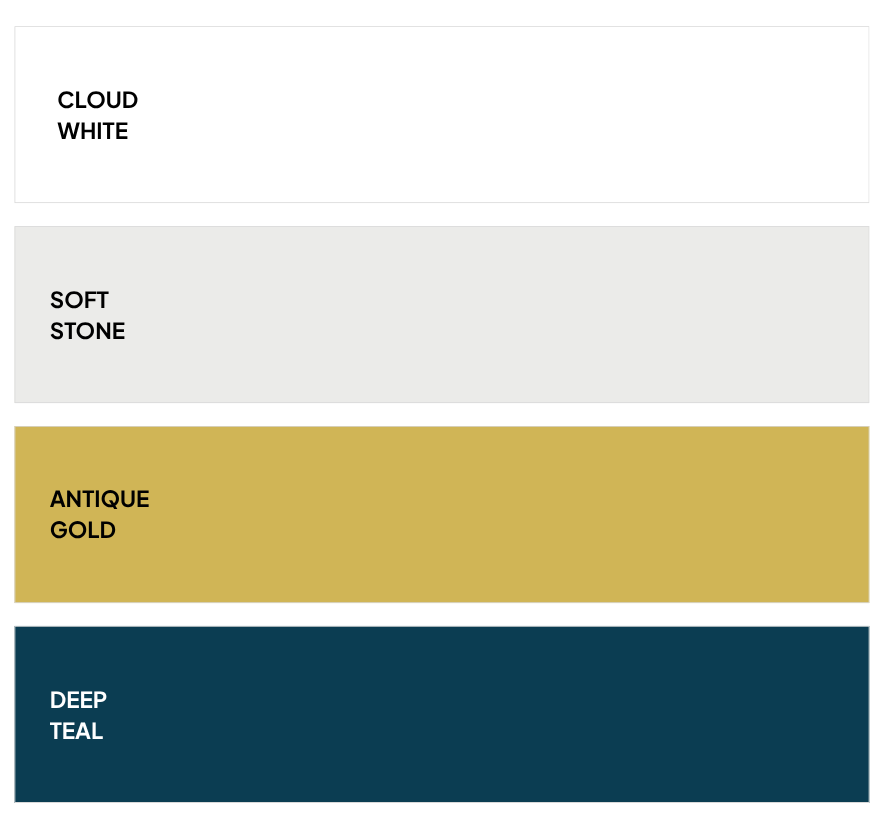
The same instinct shaped her colors. Gold, she said, "is priceless to me... learning is priceless, and being able to equip people with the knowledge, skills, and behaviors they need to be successful is what I call gold." Teal carries the water, the flow, a nod to her own heritage. The terracotta rose is "the earthy sort of human sense." Black is the classic half and the technology half at once. None of it was picked to look good. Each color stood in for something she'd already decided mattered.
It's the same idea as her tagline, translated into a picture and a palette. The chaos was never the technology. It was the people caught in the handoff. "It's a very delicate handoff," she said, describing the risk in AI orchestration. "If you miss that pass-off, you will lose millions." The image and the colors she asked for make that visible before a single word of copy is read.
03
She Had Been Drifting Since the First Conversation. Now She Knows Where to Anchor.
On the very first call, before any of the work began, Cindy reached for an image that would carry through the whole engagement: "You're just patching up your boat as you're swimming along, when if you had designed it at the beginning, you would have a much better outcome."
By the end of the Business Launch Day sessions, with the tagline set and the copy locked, she reached for the same image to describe what had changed. "I've been kind of like drifting around trying to figure out where should I anchor my boat," she said, "and now I feel like, okay, all right, I'm going to commit to anchoring it here."
Not a new metaphor. The same one, resolved.
Business Branding Results:
From Too Much Information to
One Clear Sentence
Brand Strategy
& Positioning
Brand Strategy & Positioning replaced four overlapping categories (education, nonprofit, governmental, manufacturing) with a single owned lane: AI implementation for mid-sized pharmaceutical companies, with "AI implementation" locked as her core keyword.
Brand
Deep Dive
Brand Deep Dive Named the exact reason her old title was working against her ("learning is misleading") and narrowed two competing audiences down to one named buyer, her "second-year CEO." That clarity produced the tagline: "I bring harmony to the chaos of AI implementation."
Brand Messaging
& Website Copy
Brand Messaging & Website Copy now opens with the tagline and translates twenty-five years of instructional design into business outcomes, real numbers instead of education language, so a visitor understands what she does in one sentence instead of five pages.
Website Design
& Build
Website Design & Copy, a fully designed site, built and taken live in a single day. Her own words on seeing it: "This is amazing. It's beautiful. Much cleaner than either of my two websites before."
The Instructional Designer who never wrote her own lesson plan
Cindy spent her career doing exactly what she couldn't do for herself. Handed someone else's thirty-two-step process, she could compress it, sequence it, and document it until a hundred people understood exactly what came next. She even has a name for the principle: her own rule of three. "The human brain can only manage three to four changes at a time," she tells the CEOs she works with. "Just stick to the three." It's the first thing she teaches other people about their own message.
Handed her own story, the rule didn't apply. Everything felt relevant, so nothing got cut. "I've got so many ideas," she said, describing her own writing. "Probably this doesn't belong here, but I don't know, it's so fun, I just want to throw it in." It took Calvina, mid-session, to do for Cindy exactly what Cindy does for everyone else: "I'm gonna have to need you to pick one, and the one that we pick has to align."
She named what she actually needed before the work began, more clearly than most people manage to: "I need an objective third party. I just need someone to tell me, do this, or don't do that stuff yet." That isn't a confidence problem. It's the same blind spot every instructional designer eventually runs into: you can teach anyone the rule of three, except yourself.

“I’m so excited. I feel like this is definitely a worthwhile investment. I feel so official now. I have this.”
— Cindy Au, AI Implementation Consultant
Ready for your own business branding transformation?
If you've spent your career translating other people's expertise into something people can act on, and you still can't get your own pitch under five minutes, this work is for you.